01
What a booking system that lives in your DMs really costs
Plenty of studios run their timetable through Instagram messages, a group chat and a whiteboard, and it works — at the size where the owner personally knows every member's schedule. The failure is not dramatic; it is gradual, and it is expensive in ways that never appear on a P&L.
The costs show up as evenings answering whether there is space at 6, as the double-booked reformer nobody noticed until two members arrived for one bed, and as the member who wanted to try a class on Sunday night, could not find out whether it was full, and did not follow up on Monday. That last one is the expensive one, because it is invisible.
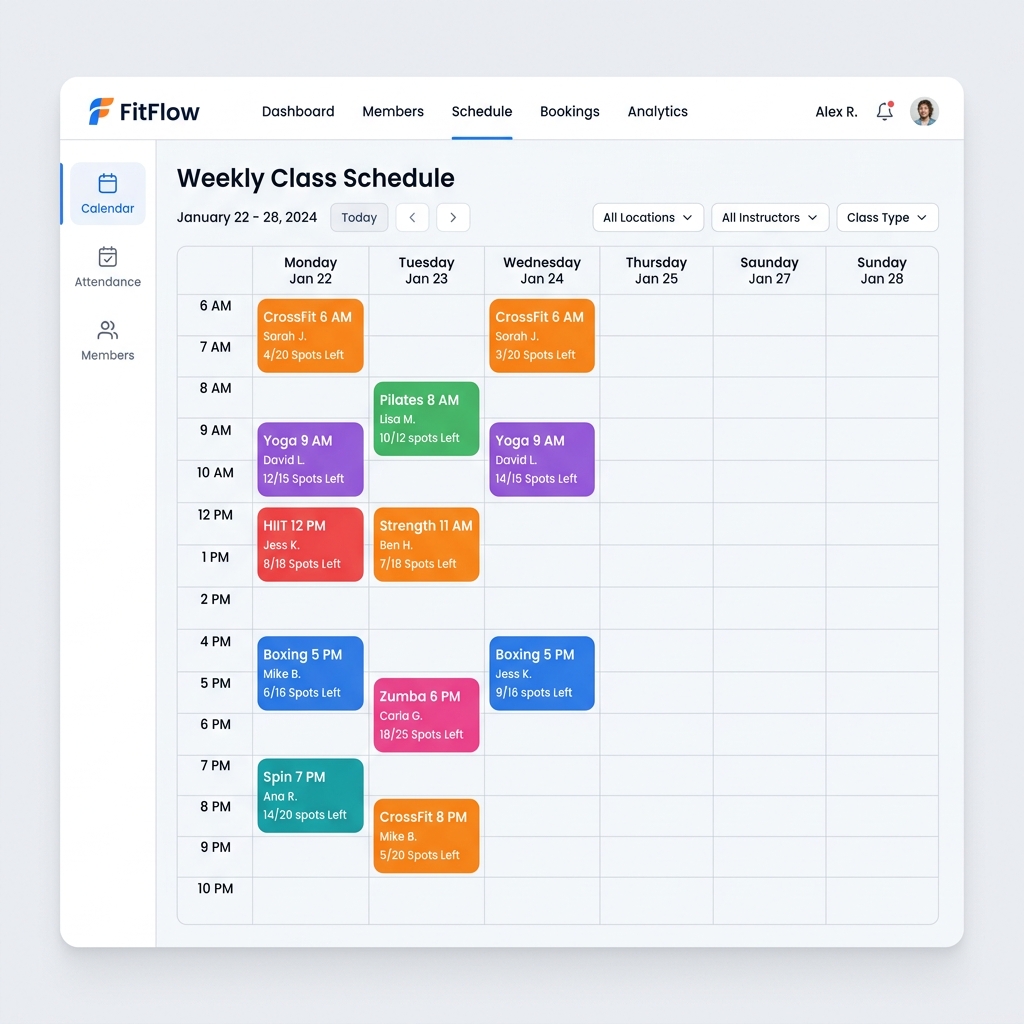
A public schedule that shows real remaining capacity converts interest at the moment it exists rather than the next time you check your phone.
02
Waitlists are the feature that pays for the software
A full class looks like a good problem until you count what it costs. Every full class turns away members who wanted to attend, and a proportion of those members quietly conclude that the membership is not working for them.
An ordered waitlist changes the economics twice. When a confirmed member cancels, the first person in the queue is promoted automatically and told they are in — no admin, no favouritism, no lost names on a scrap of paper. And when you open extra capacity, the queue tells you precisely how much demand exists for a second Saturday session, which is far better evidence for adding a class than a hunch.
The ordering matters more than it sounds. A queue that runs first-in-first-promoted is defensible to every member; a queue that depends on who messaged the owner directly is a slow-burning fairness problem in a community business.
03
Cancellation deadlines and the limits of the honour system
Late cancellations are the single most common source of friction between studios and their members, and almost every studio starts by handling them informally. The informal approach works until the studio grows past the point where the owner can personally remember who cancels late and how often.
A cutoff enforced by the system is fairer than a cutoff enforced by memory, because it applies identically to the member who has been there six years and the one who joined last week. It also removes the owner from the position of adjudicating each case, which is the part that actually causes resentment.
The important nuance is keeping a staff override for genuine emergencies. A rule with no human exception is a rule that eventually forces you to be unreasonable to someone whose circumstances deserved better — and rigid software is a poor excuse for that conversation.