01
Why gym payroll is harder than the headcount suggests
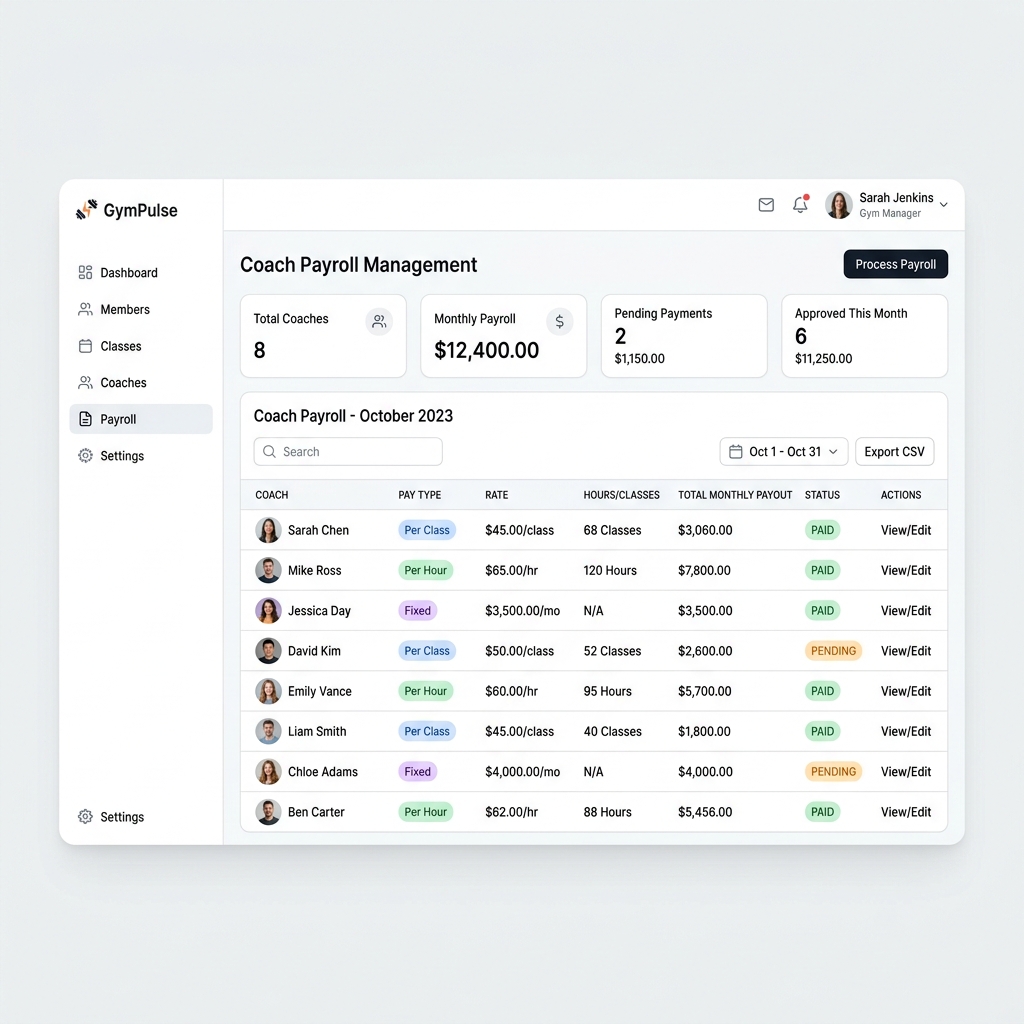
A gym with twelve staff should not be a difficult payroll problem, and yet it reliably is. The reason is that fitness businesses almost never run on one pay structure. A typical timetable involves coaches paid per class, a PT paid hourly, someone on a fixed weekly retainer, and at least one person whose arrangement is a verbal agreement from two years ago that everyone remembers slightly differently.
Reconciling that by hand means counting classes per person per fortnight, applying a different rule to each one, and hoping the schedule in your head matches the schedule that actually ran. Cover shifts, cancelled classes and last-minute swaps all introduce quiet errors, and the errors are usually discovered by the coach rather than the owner.
The fix is not a smarter spreadsheet. It is deriving the count from the schedule that already exists, so the number of classes taught is a fact rather than a recollection.
02
Per class, per hour, or fixed — and why you need all three
Software that supports one pay model forces your business to match the software. In practice, most studios need the mix.
Per-class rates suit group fitness, where the unit of work is unambiguous and a coach teaching more should earn more. Hourly suits floor shifts, personal training and admin time, where the work is not neatly divided into classes. Fixed weekly or monthly suits a head coach or studio manager whose value is not measured in contact hours at all, and paying them per class actively distorts their incentives.
Supporting all three simultaneously matters because teams change shape as they grow. The coach who started on two classes a week and moved onto a retainer should not require a workaround, and the casual who covers school holidays should not need a permanent arrangement.
03
What your accountant actually needs from you
It is worth being precise about the boundary here: WeeksPro calculates and exports the numbers, it does not pay your coaches. Money still moves through your bank transfer or your payroll provider, and superannuation, PAYG withholding and award obligations remain matters for your accountant and the ATO.
That boundary is deliberate rather than a limitation to apologise for. Payroll compliance is jurisdiction-specific and consequential to get wrong, and a gym platform that quietly took over the filing would be overreaching. What the platform can do well is remove the part that consumes your evenings — the counting, the per-coach rules, the reconciliation — and hand your accountant clean figures instead of a screenshot of a spreadsheet.
The secondary benefit is visibility you did not previously have. A monthly view of total compensation across the team turns the margin conversation from a feeling into a number, which is usually the first step to noticing that a class costing $90 in coaching is generating $60 in revenue.